September 2, 2026 · Research
GEMS can specialize before frontier-scale pretraining
Related project: GEMS / Training GroundsHistorical note (2026-09-05): This entry documents Phase 158 Generation 0 research, which explored starting GEMS from strong open pretrained foundations. That foundation-selection strategy has since been superseded: GEMS / Training Grounds is now pursued as a from-scratch model research program, and pretrained-foundation specialization work has moved to a separate, not-yet-publicly-named project. The research below is preserved as a historical record and no longer describes current GEMS architecture.
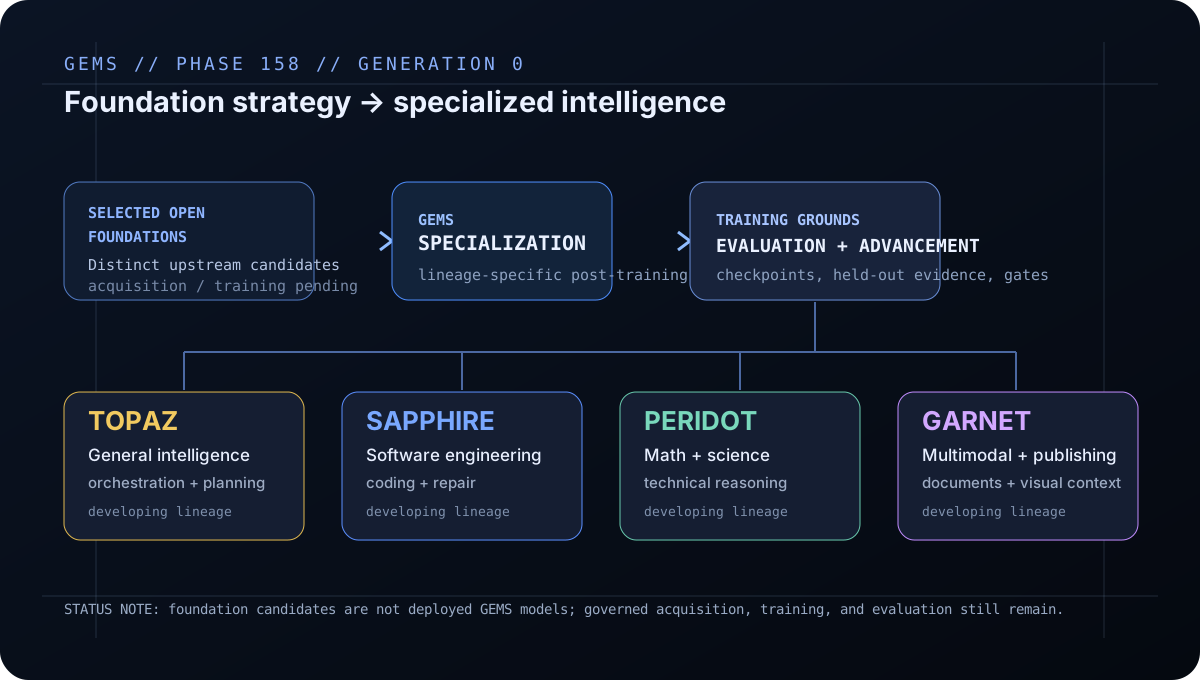
GEMS does not need to wait for the compute required to pretrain a frontier-scale foundation model before developing distinctive FDS intelligence.
Phase 158 Generation 0 has now recorded a distinct foundation candidate for each research lineage: an OLMo 2 base for Topaz’s broad language and orchestration direction, Qwen2.5-Coder for Sapphire’s software-engineering direction, Mathstral for Peridot’s mathematical and technical-reasoning direction, and SmolVLM2 for Garnet’s document and visual direction.
These selections are research inputs, not renamed products. Topaz, Sapphire, and Peridot have not acquired or trained their Generation 0 candidates. Garnet’s SmolVLM2 acquisition is incomplete and paused, and no result-bearing Generation 0 evaluation has run.
Garnet’s image-generation direction is also deliberately separate. SmolVLM2 is a vision-language foundation, not an image generator. FLUX.1-schnell is registered only as a gated, unacquired candidate for a distinct image-generation module; the research does not yet establish it as a Garnet capability.
Training Grounds can apply post-training, curriculum design, domain specialization, agentic and tool-use work, held-out evaluation, and controlled advancement once the applicable gates are satisfied. The goal is to teach and verify each role, not merely rename an upstream checkpoint.
This is an evolution of the engineering strategy, not an abandonment of the original ambition. As compute, datasets, funding, and research capacity grow, GEMS may move toward deeper FDS-developed foundations and eventually full foundation-model work.
Affordability and frontier-like usefulness remain targets. They are not claims that the current GEMS family has reached frontier parity.